


Airbnb Hosting in Buy-to-let Property | Tax on Airbnb Income
Learn how to navigate the tax rules around Airbnb hosting in your buy-to-let property, and boost your rental income.

Airbnb hosting has become popular in recent years with increasing number of landlords in London and outside London are using Airbnb as an easy platform to let their buy to let property and own house.
With this popularity, increasing number of our client asks for detailed guidelines on tax on Airbnb hosting income.
In this Article, we will outline the main tax provisions applicable to Airbnb income.
Do I have to Pay Tax on Airbnb Income?
Yes- subject to some reliefs.
Airbnb hosting income is same as any other income and so taxable in the UK. The tax treatment and relief depend on whether the property is your main residence or not.
- Renting one or more furnished rooms within your main residence (property where you live)
- Renting another buy-to-let property
Airbnb Hosting within Your Main Residence (Rent a Room Scheme)
If you rent out room within the property where you live, you will qualify for the Rent-a-room scheme. As a result, you will get a tax free allowance of £7,500 per year.
You will qualify for the scheme even if you don’t own the house or flat. Also, you will qualify even if you are running bed & breakfast or guest house as long as it is within your main residence where you are living and furnished.
So, most of Airbnb landlords will qualify for the rent-a-room scheme for letting within their main residence.
The tax-free allowance of £7,500 is not an allowance on profits. It is allowance on gross rent receipts, i.e., total receipts before deducting any expenses. If your gross rent receipts are less than £7,500 in a tax year, you even don’t need to declare this in a tax return as the income is automatically exempt.
Note: The limit will reduce to £3,750 if two persons receive the income from the same property. For example, you and your spouse both receives income from the same property, each of you will be able to use allowance of only £3,750 instead of £7,500.
Options Available if Your Income Exceeds £7,500
If your gross rental receipts are more than £7,500, you have two options:
You may be better off with Option 2 if your total expenses are less than £7,500. Otherwise, option 1 may be better. You can switch between these options each year. So, you may be better off with option 1 in one tax year while with option 2 in another tax year!
Airbnb Hosting in Buy to let Property
If you are hosting your Airbnb guests in separate house/flat (i.e. not within your main residence), you will not qualify for the rent a room scheme.

Unfortunately, you will not get a tax-free allowance of £7,500. In this case, you will be taxed on your rental profits like any other business. For example, suppose your total rental receipts in the tax year are £15,000.
You incurred total allowable expenses (such as gas, electricity, insurance, repairs, etc.) of £5,000, then your rental profits is £10,000, and you will pay tax on £10,000 based on your income tax rate.
However, please be aware that mortgage interest on residential lettings is restricted under Section 24. Instead of deducting the interest as an expense, you receive a tax credit at the basic rate of 20%. Since 6 April 2025 this applies to Airbnb lettings too, as explained below.
What Happened to the Furnished Holiday Letting (FHL) Rules?
Until 5 April 2025, a buy-to-let property let via Airbnb could qualify as a Furnished Holiday Letting (FHL) and receive more favourable tax treatment. The FHL regime was abolished from 6 April 2025 for Income Tax and Capital Gains Tax (1 April 2025 for Corporation Tax). Short-term lets are now taxed in the same way as any other UK property business.
These conditions now matter only for a few transitional rules, such as Business Asset Disposal Relief on a former FHL business that ceased before 6 April 2025 (see below). Income and gains arising on or after 6 April 2025 are taxed as part of your ordinary property business.
Will Section 24 (Restriction on Tax Relief on Interest) Apply to Airbnb?
Yes. Since 6 April 2025, Section 24 applies to Airbnb and other short-term lets in the same way as long-term residential lets. Former FHL landlords can no longer deduct mortgage interest in full.

The Section 24 restriction means mortgage interest is not deducted from rental income. Instead, you receive a tax credit of 20% of the interest, which mainly affects higher-rate and additional-rate taxpayers.
Moving from long-term lettings to Airbnb no longer brings the tax advantages it did under the FHL rules, so the decision should rest on the commercial return, the extra running costs and any planning or licensing rules in your area.
Refer to our detailed guide on "interest relief restriction on section 24 on landlords" for more detail.
Are There any Extra Reliefs from Capital Gains Tax for Airbnb Landlords?
Not for disposals on or after 6 April 2025. Before then, the main capital gains tax reliefs depended on whether you qualified as a ‘Furnished Holiday Letting’ business.
Since the FHL regime ended, a gain on selling an Airbnb property is generally taxed like any other residential property gain, at 18% or 24% for 2026/27. The former FHL reliefs have been withdrawn, subject to limited transitional rules:
Business Asset Disposal Relief
FHL owners could previously claim Business Asset Disposal Relief (BADR) when selling an FHL business. BADR is no longer available for disposals of former FHL property on or after 6 April 2025, except where the FHL business ceased before that date and the disposal takes place within three years of cessation. For qualifying disposals on or after 6 April 2026, BADR gives a rate of 18% (14% in 2025/26), so the saving compared with the 24% higher rate is now much smaller.
The conditions for these transitional rules are strict, so take advice before selling a former FHL property. As property tax experts, we are happy to help you on this.
Rollover Relief
Before 6 April 2025, if you sold an FHL property and reinvested in another qualifying business asset, you could defer the gain with rollover relief. This relief is no longer available for former FHL property disposed of on or after that date.
An anti-forestalling rule, effective from 6 March 2024, also stops unconditional contracts being used to secure the old FHL reliefs. If you sold or reinvested around April 2025, it is best to check your position with a property tax expert.
Other reliefs from Capital Gains Tax
Other reliefs linked to FHL status, such as relief for loans to traders and, for companies, the substantial shareholding exemption, have also been withdrawn. Private Residence Relief can still apply to any period when the property was your only or main home.
However, as with the other reliefs, there are various conditions you need to meet, and so it is best to discuss with a property tax expert in advance of the sale.
Gift Relief
Before 6 April 2025, FHL owners could claim gift holdover relief when giving away an FHL property, so no capital gains tax was paid at the time of the gift and the gain passed to the recipient. Gift holdover relief is no longer available for former FHL property given away on or after 6 April 2025.
Gifts of property to a qualifying charity remain free of capital gains tax under separate rules, whether or not the property was ever an FHL.
Are There Any Other Tax Advantages of Being an Airbnb Landlord?
Not any more, for most landlords.
Until 5 April 2025, landlords who met the FHL conditions had several advantages over typical buy-to-let landlords. From 6 April 2025 these have been removed:
- Pension contributions: FHL profits counted as relevant UK earnings for pension tax relief. Profits arising from 6 April 2025 no longer count.
- Capital allowances: FHL landlords could claim capital allowances on furniture, fixtures and equipment. New expenditure from 6 April 2025 is instead covered by replacement of domestic items relief, although existing capital allowance pools can continue to be written down.
- Mortgage interest: FHL landlords could deduct interest in full. Section 24 now applies instead.
- Losses: FHL losses could only be used against future FHL profits. Losses carried forward from a former FHL business can now be set against future profits of your UK (or overseas) property business.
You can get a comprehensive understanding of Tax on Rental Income UK on our full-fledged guide.
Do I Need to Charge VAT on Airbnb Letting?
Yes - if you are, or need to be, VAT registered.
This is one of the very important distinctions between normal letting and Airbnb letting. The residential rental income is exempt from the VAT in the UK.
However, Airbnb-type lettings are treated more like hotels than typical buy-to-let residential lettings. Holiday accommodation, and serviced flats used by visitors, are excluded from the VAT exemption for land and so are standard rated. This means you need to charge VAT at 20% on what you charge your guests.
But you do not need to register if your VAT taxable turnover does not exceed the VAT registration threshold, which is £90,000 (from 01/04/2024).
However, if your income exceeds the threshold, you need to register for VAT and file regular VAT returns to HMRC. The turnover for VAT includes the full amount you charged to the guest (including rent, meals, cleaning, etc.)
VAT rules are detailed and complicated, and some lettings are treated differently, so it is worth taking advice on your own position.
For Example,
If you provide serviced accommodation that counts as a hotel-type “similar establishment” and a guest stays for more than 28 consecutive days, a reduced value rule applies from day 29. VAT is then due only on the part of the charge that is not for the accommodation itself (at least 20% of the charge). The letting is still taxable, not exempt. This rule does not apply to holiday accommodation, although off-season residential lets of more than 28 days in a seasonal holiday area can be exempt. So, you need to consult with a property tax expert for further advice on this.
VAT Implication on Airbnb Income
For many years, there has been uncertainty surrounding the VAT treatment of the Serviced Accommodation business in the UK. This type of lodging or accommodation service offers fully furnished properties or apartments for short-term stays, providing guests with essential amenities and utilities similar to a hotel room, along with the convenience of a fully functional kitchen, living area, and other household facilities – essentially, services provided through platforms like Airbnb.

Notably, Serviced Accommodation businesses are significantly affected by the normal VAT rules. Some operators have argued that the Tour Operators Margin Scheme (TOMS), which charges VAT only on the operator’s margin, should apply to them.
In Sonder Europe Limited, the First-tier Tribunal ([2023] UKFTT 610 (TC)) initially agreed that serviced apartments leased from landlords and let to short-stay guests could fall within TOMS. However, on 14/01/2025 the Upper Tribunal allowed HMRC’s appeal ([2025] UKUT 14 (TCC)), holding that TOMS only applies where a bought-in supply is passed on for the direct benefit of the traveller.
Where an operator leases a property (an exempt supply of land) and uses it to provide short-stay accommodation, it is making its own supply rather than reselling a bought-in travel service, so TOMS does not apply.
As a result, Airbnb and Rent to Rent Serviced Accommodation businesses that operate in this way should not rely on TOMS. Their lettings will generally be standard-rated on the full price charged to guests once they are VAT registered. If you have accounted for VAT under TOMS on this basis, you should take advice on your position.
Airbnb Landlords Targeted by HMRC's One to Many (OTM) Letter Campaign
HMRC's One to Many (OTM) letter campaign is a tax compliance initiative aimed at identifying taxpayers who may not have declared all of their income or paid the correct amount of tax. One area that has been targeted by this campaign is income from short-term property letting, such as those listed on Airbnb.
If you have been renting out a property on Airbnb and have not declared this income on your tax return, you may receive a letter from HMRC as part of the OTM campaign as the one below:
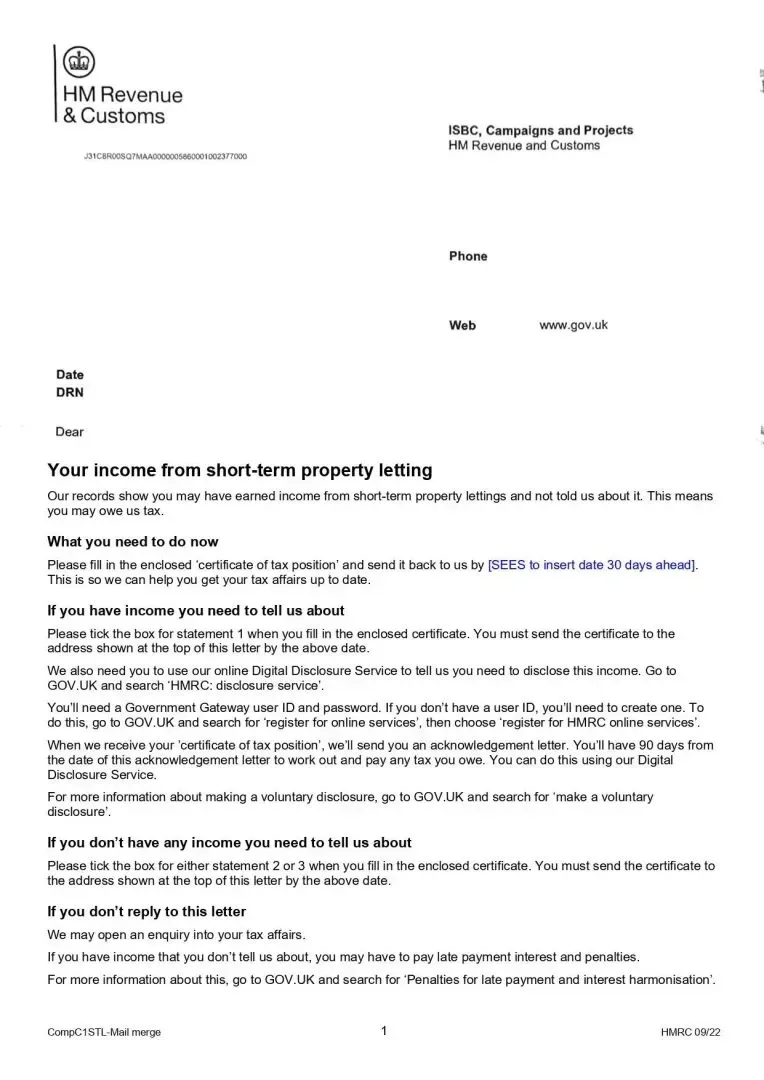
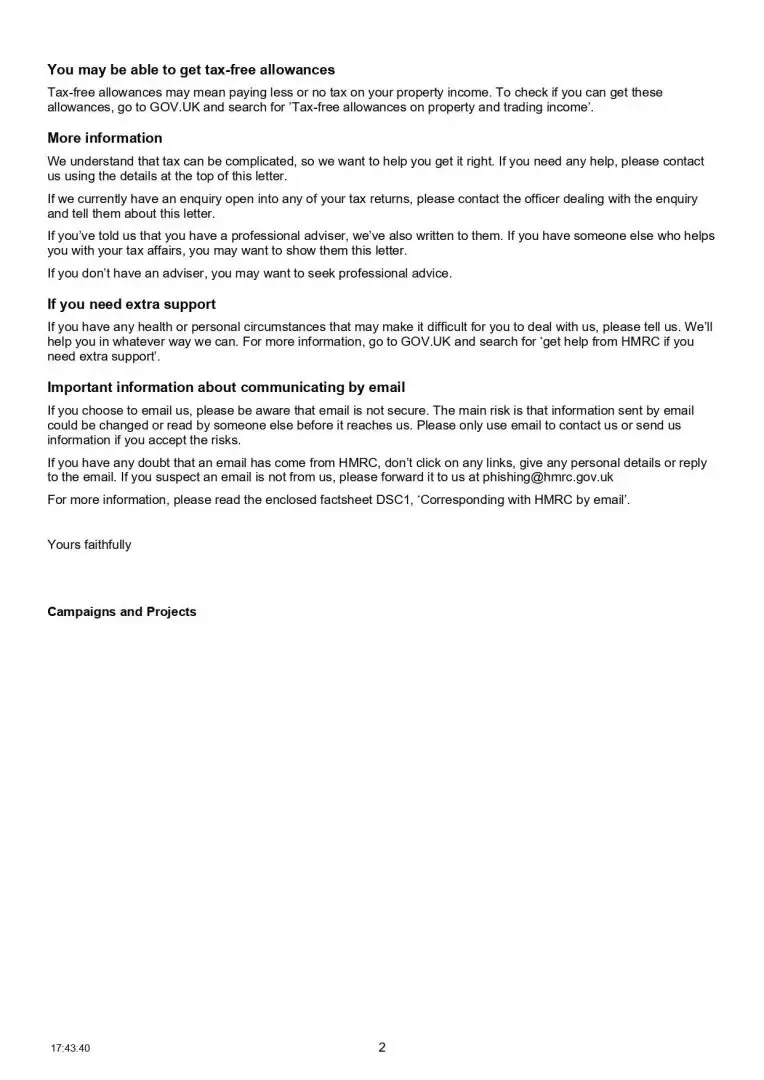
The letter will ask you to review your tax affairs and make sure you have paid the correct amount of tax on your Airbnb income. If you do receive a letter from HMRC as part of the OTM campaign, it's important to respond promptly and take action to ensure your tax affairs are in order. Failing to do so could result in further action, including penalties and interest charges.
Learn more about Short-Term Property Letting Income on our comprehensive guide.
Warnings to Landlords in London!
The Greater London Council (General Powers) Act 1973 states that the use of residential premises for temporary sleeping accommodation (for less than 90 consecutive nights) is a change of use for all 32 boroughs of London, for which planning permission is required.
However, the good news is that the UK Government has relaxed this in Deregulation Act 2015 to promote Airbnb type lettings.
The new rule means that you can let up to 90 days in a calendar year without breaching this regulation. Airbnb automatically limits the number days for listing to 90 days. Read more about this on Airbnb website and UK Government website.
Before 6 April 2025, this 90-night limit mattered for tax because it could stop a London property qualifying as a furnished holiday letting. Since the FHL regime has been abolished, the limit no longer affects your tax treatment, but letting for more than 90 nights a year in London without planning permission can still breach planning rules.
Take Control of Your Airbnb Income Tax
Contact Us for Expert Guidance and Ensure Maximum Returns
Contact UsAbout the author
Raju Gajurel is a qualified chartered accountant and tax adviser with more than 22 years of experience. He specialises in property taxation and has been recognised for offering unmatched advice to investors and developers. Formerly at KPMG, BDO, he provides comprehensive accounting and tax planning and is a certified Chartered Financial Analyst (CFA).
Introducing RentalBux: Our MTD Software for Landlords
Generic software doesn’t understand property businesses and requires manual intervention to meet deadlines. That’s why we developed RentalBux!
- Built by Property Experts
- Designed for UK Landlords
- HMRC Recognised and MTD Compliant

Confused Where To Start?
Schedule a Free 15-minute discovery call by providing your contact details, mentioning your requirements, and selecting a convenient date for the call.
How our discovery call works:
- Complete Our Contact Form
- Discovery Calls Scheduled
- Receive a Tailored Proposal