

How Capital Gains Tax Has Evolved Over the Years
The Labour and Conservative parties have both contributed towards the changes in how Capital Gains Tax (CGT) is taxed and its rate changes.

Capital Gains Tax (CGT) in the UK is paid on the chargeable gains made on the sale of a property or any other asset. The CGT rate was first capped at 15%, but it has fluctuated over the years by both Labour and Conservative governments.
With Labour’s budget just around the corner, many believe a CGT rate hike will be the budget’s main agenda. This speculation comes after Labour pledged not to increase the three main taxes, Income Tax, VAT, and National Insurance Contributions (NICs), in their pre-election manifesto. However, the government have been tight-lipped about their changes to CGT rates.
So, we are taking a closer look at how Capital Gains Tax has evolved over the years, its history, and under which government the rates have been more frequently increased.
Update (31 October 2026): This article was written before the Autumn Budget on 30 October 2024. That Budget raised the main CGT rates on assets other than residential property from 10% and 20% to 18% and 24% from 30 October 2024, so the same rates now apply to all assets. The Business Asset Disposal Relief rate rose from 10% to 14% from 6 April 2025 and to 18% from 6 April 2026. CGT rates were not aligned with income tax rates. The Autumn Budget on 28 October 2026 left the main CGT rates unchanged but announced that the Business Asset Disposal Relief lifetime limit will fall from £1 million to £500,000 for disposals from 6 April 2027, alongside a proposed new Founders’ Relief.
What is Capital Gains Tax (CGT)?
Capital Gains Tax (CGT) is paid on the profit made after disposing of an asset. The asset can be property, land, shares, or another type of asset. The disposing of an asset can include:
- Selling the property or asset
- Giving it away as a gift to your spouse, civil partner or charity
- Transferring it to someone else
- Swapping it for something else
- Getting compensation for it, such as an insurance payment if the asset has been lost or destroyed
For example, if you bought a property for £125,000 and later sold it for £150,000, the profit you made on the sale of your property will be £25,000. So, you will pay CGT on that £25,000.
The Early History of CGT in the UK
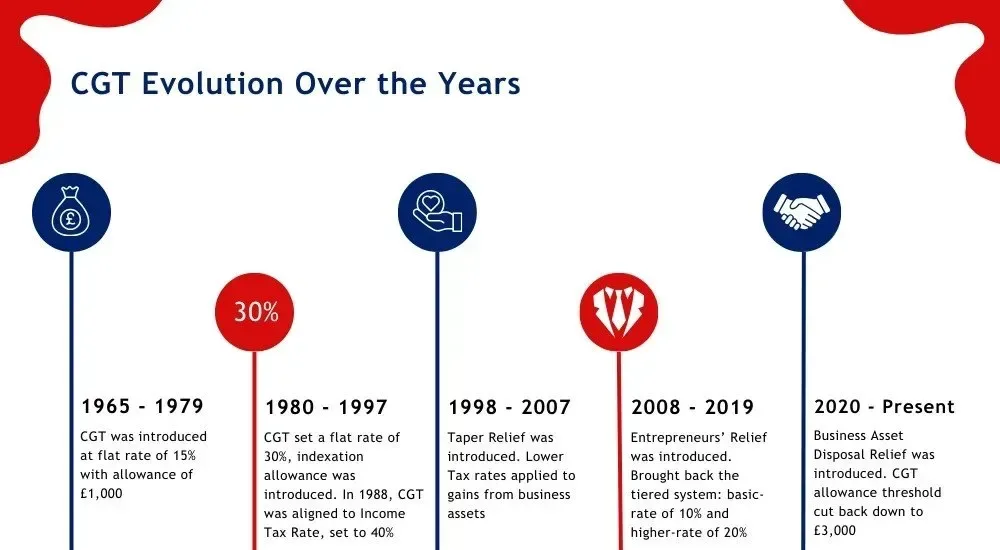
Capital Gains Tax was first introduced by Labour Chancellor James Callaghan in 1965 with the Finance Act. CGT officially commenced on 6 April 1965. Here is more on how CGT evolved since its first introduction:
First Introduction (1965 – 1979)
After the end of World War II, the value of property, land, and other assets increased greatly. The high Income Tax rate at the time led people to invest in properties and other assets to avoid paying taxes. So, with the aim of collecting tax on chargeable gains, CGT was introduced under the Finance Act of 1965.
Initially, the Capital Gains Tax was set at a rate of 15%. An allowance of £1,000 a year was given. So, only chargeable gains above the £1,000 threshold were subject to tax. For instance, if a property investor bought a property for £100,000 and sold it for £150,000, at 15% the investor would have to pay £7,350 CGT (if we do not take any allowable expenses into consideration).
Universal CGT Rate (1980 – 1997)
In 1980, Conservative Chancellor Sir Geoffrey Howe set the Capital Gains Tax rate to a flat 30%. Two years later, in 1982, an indexation allowance was introduced. This allowance helped people to avoid paying taxes on inflation. It adjusted the cost of assets based on inflation, so you only paid tax on the real profit, not the value increased by inflation.
Again, in 1988, Howe’s successor, Nigel Lawson, made changes to this rule. CGT was paid based on the market value of the assets as of 31 March 1982, making it the starting point for calculating gains. So, any gains made before that date were untaxed. Also, the CGT rate was increased to 40%, aligning it with the Income Tax rate of that time.
Taper Relief (1998 – 2007)
In 1998, Labour Chancellor Gordon Brown made further changes to CGT. He replaced the indexation allowance with taper relief. Taper Relief reduced the amount of tax owed the longer a taxpayer owned an asset. However, it no longer took inflation into account.
Brown also made reforms to encourage entrepreneurship, offering lower tax rates on business assets compared to non-business assets. This reform rewarded people for taking risks and starting new businesses.
Entrepreneurs’ Relief (2008 – 2019)
In 2008, Labour Chancellor Alistair Darling abolished Taper Relief. Instead, he introduced a simpler system of a flat rate of CGT at 18%. He also introduced Entrepreneurs’ Relief, which aimed to promote investment among investors. This relief applied a lower rate of 10% on gains made by business owners, directors, and stakeholders on the disposal of business assets and company shares. There was a lifetime limit on the Entrepreneurs’ Relief set at £1 million. This amount was increased to £10 million by 2010.
The 18% flat rate did not last long, as Conservative Chancellor George Osborne brought back the tiered system in 2010, raising the higher rate to 28%. Osborne then introduced two rates in 2016: 10% for the basic rate and 20% for the higher rate. Also, higher rates applied to any gains made from the sale of second homes.
Business Asset Disposal Relief (2020 – present)
Conservative Chancellor Rishi Sunak brought down the Entrepreneurs’ Relief limit from £10 million to £1 million in 2020. Since 2020, the threshold allowance of CGT has increased to £12,300 in the 2020/21 tax year. This threshold was cut to £6,000 in the 2023/24 tax year and to £3,000 in the 2024/25 tax year.
Rate Changes Under Labour and Conservative Government
The two major parties of the UK, the Labour Party and the Conservative Party, have both contributed towards the major changes in how CGT is taxed and its rate changes. The Labour government tends to promote long-term investments with the introduction of Taper Relief and Entrepreneurs’ Relief. On the other side, the Conservative government focuses more on a balanced approach and promotes a tiered system. Here is a table containing the key changes based on the government:
Labour Government
| Chancellor | Changes | CGT Rate |
|---|---|---|
| James Callaghan | Introduced Capital Gains Tax (CGT). | 15% |
| Gordon Brown | Introduced Taper Relief and provided lower rates for business assets. | No set CGT rate. However, it could be reduced to as low as 10% based on how long the asset was held and if it was a business asset. |
| Alistair Darling | Introduced Entrepreneurs’ Relief. | 18% Lifetime limit on Entrepreneurs’ Relief set to £1 million. |
Conservative Government
| Chancellor | Changes | CGT Rate |
|---|---|---|
| Sir Geoffrey Howe | Set a flat rate of CGT and introduced an indexation allowance. | 30% |
| Nigel Lawson | Aligned CGT rate with Income Tax rate of that time. | 40% |
| George Osborne | Brought back the tiered system. | Basic rate: 10% Higher rate: 20% |
| Rishi Sunak | Made cuts in the tax-free CGT threshold. | Threshold: £3,000 Basic rate: 18% Higher rate: 24% |
What is the Current CGT Rate?
The rate you pay for CGT used to differ between gains on residential property and gains on other assets. Since 30 October 2024, the same rates apply to both. The CGT rates for 2026/27 are as under:
| Tax Brackets | Income Range | CGT rate on property | CGT rate on assets |
|---|---|---|---|
| Basic Rate | £12,571 to £50,270 | 18% | 18% |
| Higher Rate | £50,271 to £125,140 | 24% | 24% |
| Additional Rate | Above £125,140 | 24% | 24% |
There is an annual allowance threshold of £3,000 for the 2026/27 tax year. So, if your gain is £15,000 when selling a residential property, £3,000 will be deducted, resulting in capital gains of £12,000.
Let us take an example to understand the CGT rates and allowances better.
Mr Williams earns £25,000 from his employment income and is selling his residential property, resulting in a gain of £10,000. After deducting the annual capital gains allowance of £3,000, his taxable capital gain is £7,000. Since his combined income is £32,000 (£25,000 plus £7,000), which is below the basic rate threshold of £37,700 for the 2026/27 tax year, the capital gains tax rate applicable would be 18%.
What is the Future of CGT Rate?
Currently, the Labour government is in desperate need of raising government funding due to a £22 billion funding gap. With announcements of the government avoiding raising Income Tax, VAT, and National Insurance Contribution (NIC) rates, there is a high possibility of a CGT rate rise in the upcoming autumn budget.
Property and tax experts are anticipating a higher rate of CGT between 33% and 39%. However, there is some speculation about CGT rates aligning with the current Income Tax rates. Here is a table showing the current income tax rates:
| Tax Brackets | Taxable Income | Tax Rate |
|---|---|---|
| Personal Allowance | Up to £12,570 | 0% |
| Basic Rate | £12,571 to £50,270 | 20% |
| Higher Rate | £50,271 to £125,140 | 40% |
| Additional Rate | Above £125,140 | 45% |
Experts are also anticipating something called a Double Death Tax. This would apply CGT on top of Inheritance Tax on any property or assets passed on by a family member.
These possible CGT changes are highly speculative based on the history and the current situation of the Labour government. With less than a week left for Chancellor Rachel Reeves to deliver her first budget, UK property investors and taxpayers are keeping their eyes peeled for 30 October.
Conclusion
Capital Gains Tax (CGT) has evolved significantly over the decades. Both Labour and Conservative governments have influenced its development. Labour has supported long-term investments and entrepreneurship with reliefs like Taper Relief and Entrepreneurs’ Relief. Conservative governments have often used a tiered system to balance business incentives with taxation.
There is speculation about a potential increase in CGT rates in the upcoming Labour budget. UK taxpayers and property investors are waiting to see what will happen. Since CGT rates change often, understanding its history can help us predict how future changes might affect personal and business investments.
About the author
UK Property Accountants is a specialist property tax and accounting firm serving clients across the UK and abroad. With over 10,000 properties under active accounting management, £8 billion in assets under accounting, clients spanning 57 countries, and an expert team of ACCAs and CTAs, we bring a depth of real-world property tax experience rarely found in any single firm. We hold a 99% client satisfaction rate and an Excellent rating on Trustpilot. All published content is reviewed by qualified professionals in line with current HMRC guidance.
Introducing RentalBux: Our MTD Software for Landlords
Generic software doesn’t understand property businesses and requires manual intervention to meet deadlines. That’s why we developed RentalBux!
- Built by Property Experts
- Designed for UK Landlords
- HMRC Recognised and MTD Compliant

Confused Where To Start?
Schedule a Free 15-minute discovery call by providing your contact details, mentioning your requirements, and selecting a convenient date for the call.
How our discovery call works:
- Complete Our Contact Form
- Discovery Calls Scheduled
- Receive a Tailored Proposal