

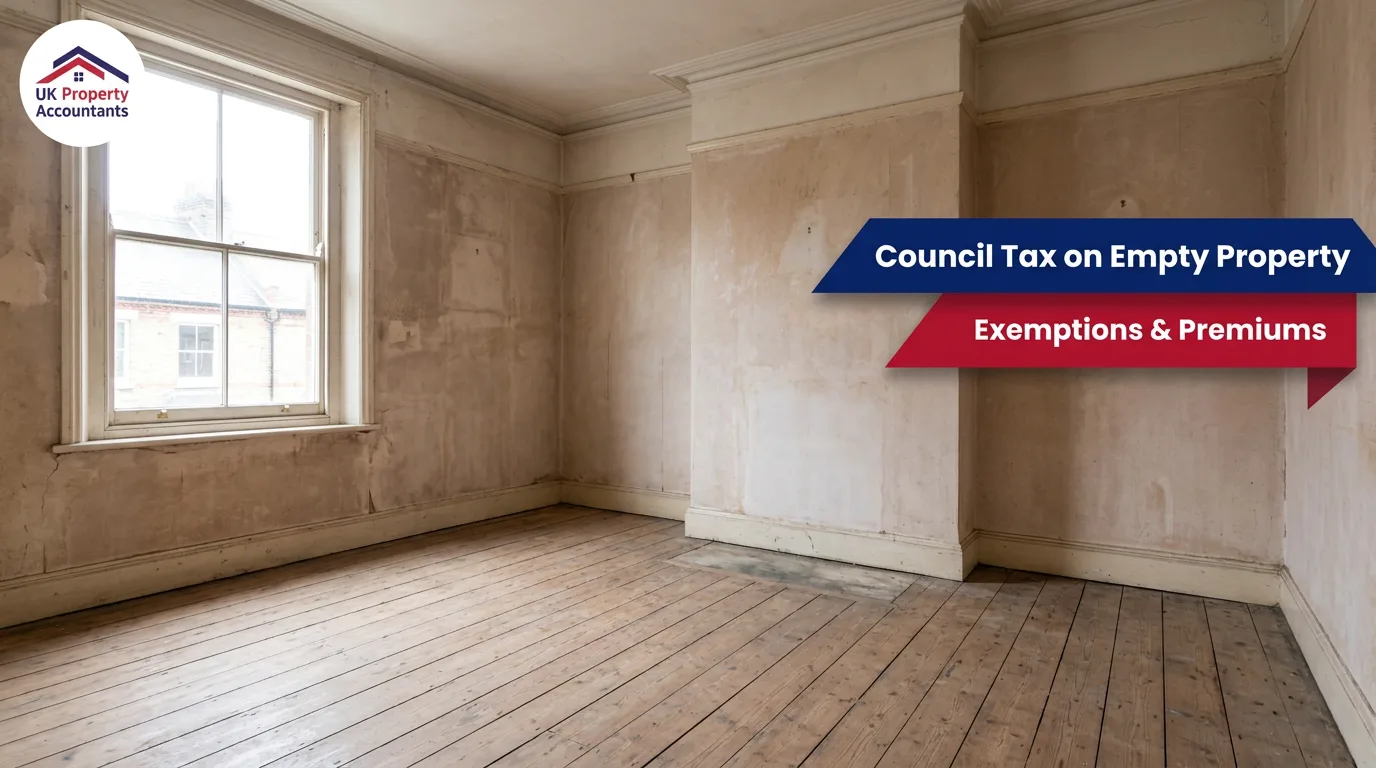
Council Tax on Empty Property
Learn about council tax rules for empty properties, including exemptions, discounts, and premiums on long-term vacancies.

Council tax is a tax paid to local councils in respect of the domestic properties where an individual permanently lives. The local councils collect the council tax to enable them to deliver local services to the community. Although there are some instances when the council tax may not be payable, it is generally payable by anyone who is over 18 and rents or owns a home.
Where the property is let out, it is generally the responsibility of the tenants to pay the council tax bill. However, this responsibility shifts to the landlords in cases of Houses in Multiple Occupations (HMOs). This article explores specific details related to council tax, starting with the person responsible for making council tax payments.
Who Pays Council Tax?
As previously mentioned, it is generally the responsibility of the person occupying the property to pay the council tax. If a property is occupied by spouses or civil partners, the bill must be paid by the spouses or partners, jointly. However, under certain circumstances, the responsibility falls on the owner of the property to make the payment. These circumstances include:
- Empty homes
- Nursing homes, houses of religious communities, residences of ministers of religion
- Houses in multiple occupation (HMO)
- Residences of staff who live in a house also occupied by the employer
If the tenants of HMOs are wrongly charged for the council tax, they must contact their local council and seek advice on the next steps.
Council Tax Computation
The council tax on a property depends on the council tax bands and the local council charges for that band. The tax bands are based on the valuation of property on 1 April 1991. If the property was more recently built, the Valuation Office Agency (VOA) will value the property based on what it would have been worth on 1 April 1991.
If you believe that your property is in the wrong council tax band, you might be able to challenge the tax band. You must have evidence supporting your claim and submit the challenge to the VOA. An example of supporting evidence could be the details about similar properties that are in lower tax bands.
Council Tax for Full-Time Students and Disabled People
If a property is occupied by full-time students, the property may be exempted from council tax. Usually, the council bill will not be sent to such properties. The students who receive the bill can apply for an exemption using HMRC’s website. As mentioned earlier, the exemption only applies to full-time students.
HMRC defines full-time students as someone whose course lasts at least a year, involving at least 21 hours of study per week. If the property is occupied by the foreign citizen spouses or dependents of the students, the exemption still applies.
Where the full-time students share the property with individuals who are not full-time students, those individuals will need to pay the council tax. However, the council tax on such properties may receive a 25% discount if they apply for the discount. The procedure for applying for the discount is the same as applying for an exemption from council tax, as explained earlier.
Do Landlords Need to Pay Council Tax on Empty Property?
Yes, landlords generally must pay council tax on an empty home. However, local councils often offer discounts on empty homes. The discounts are given at the discretion of the local councils, and councils consider various factors before deciding to grant the discount. Some instances when the local discount could include the period when the home is undergoing major repair work or structural changes. As the eligibility for the discounts may vary on each council, it is advisable to contact the local council.
It's not always that an empty property is charged a council tax. Homes that meet certain requirements are exempt from the council tax and will not have to pay any council tax. For instance, when a home is unfit for habitation or when the home is empty because it was compulsorily purchased by a relevant authority.
Long-Term Empty Properties
When a property has been empty and unfurnished for at least a year, the councils generally add a premium to the council tax bill. This is done to encourage the landlords to bring the home back into use. In normal cases, the premium charged is a 100% increase from the normal council tax.
If the property remains empty for at least 5 years, the premium rises to 200% and could go up to 300% if the property remains empty for at least 10 years.
As the time frame applies to the property and not the ownership, one must be cautious when purchasing a property that has remained empty for a considerable period of time. If the property is considered derelict or uninhabitable, individuals can ask the Valuation Office Agency to remove the property from the Council Valuation list, and the council tax bill will no longer be issued.
Delve into our complete guide to learn "Council Tax on Commercial Property". Read Now!
How is Council Tax Affected if the Person Occupying the Property Dies?
When a property becomes empty due to the death of the owner, the property is exempt from council tax until the probate is granted. Once the probate is granted, a further 6 months' exemption may be possible as long as the property remains unoccupied and has not been sold or transferred. However, the executors of the estate must pay the full council tax on the transfer.
Paying the Council Tax Bill
The methods of paying the council tax bill and due dates are generally specified in the yearly council tax bill. Although the council tax is split into 10 monthly payments, individuals may be able to spread the payments over 12 months instead to ease the burden. While the general practice is to pay the bill online, councils may offer direct debit options to individuals. To arrange a payment method that best suits your needs, you must contact your local council.
Conclusion
In conclusion, council tax obligations on empty properties can vary depending on local council policies and specific circumstances. While landlords are generally responsible for paying council tax on unoccupied homes, discounts or exemptions may apply, particularly during major repairs or when a property is uninhabitable. It's important for property owners to stay informed about their local council's rules and to understand potential premiums on long-term empty properties. Careful consideration is needed, especially when purchasing or inheriting properties that have been vacant for extended periods, to avoid unexpected council tax liabilities.
About the author
Susan Basnet, a dedicated ACCA Affiliate, excels in accounting standards, auditing and taxation. He aims to bridge the gap between theoretical knowledge and practical applications, providing companies with support to achieve optimal results in areas where they need it.
Introducing RentalBux: Our MTD Software for Landlords
Generic software doesn’t understand property businesses and requires manual intervention to meet deadlines. That’s why we developed RentalBux!
- Built by Property Experts
- Designed for UK Landlords
- HMRC Recognised and MTD Compliant

Confused Where To Start?
Schedule a Free 15-minute discovery call by providing your contact details, mentioning your requirements, and selecting a convenient date for the call.
How our discovery call works:
- Complete Our Contact Form
- Discovery Calls Scheduled
- Receive a Tailored Proposal