


Tax on Foreign Income UK: A Comprehensive Guide for UK Residents
Learn about UK tax on foreign income, reporting requirements, and how to avoid double taxation with foreign income relief and tax credits.

Foreign income means any money you earn from outside England, Scotland, Wales, and Northern Ireland. This definition is wider than many people think and covers several types of income.
If you live in the UK and earn money from outside the country, it’s important to know your tax on foreign income UK responsibilities. This guide covers what foreign income is, when you need to report it, and how to avoid being taxed twice on the same money.
Types of Foreign Income
- The most common type of foreign income is wages or salary from work you do outside the UK. If you travel for business, the money you earn for those days abroad counts as foreign income for UK tax purposes.
- Investment income from abroad is also considered foreign income. This includes dividends from international shares, interest from savings in foreign banks, and returns from other overseas investments, all of which fall under the tax on foreign income UK rules.
- If you rent out property outside the UK, you must also declare this rental income. Whether it’s a holiday home in Spain or an investment property in the US, the rent you receive counts as foreign income.
- You also need to declare pension income from schemes based outside the UK, even if you worked for a British company that set up your pension abroad.
- Income from the Channel Islands or the Isle of Man is also treated as foreign income for UK tax, even though these places are close to the UK and have historical ties.
Who Needs to Report Tax on Foreign Income UK?
If you're considered a resident of the UK for tax purposes, you have an obligation to inform HM Revenue and Customs (HMRC) about your foreign income. This requirement applies even if you've already paid tax on that income in another country. However, foreign students usually do not pay tax on foreign income UK used for course fees or living costs.
Your residence status is decided by the Statutory Residence Test. This test looks at things like how many days you spend in the UK, your connections to the country, and your work habits.
How to Report Foreign Income UK?
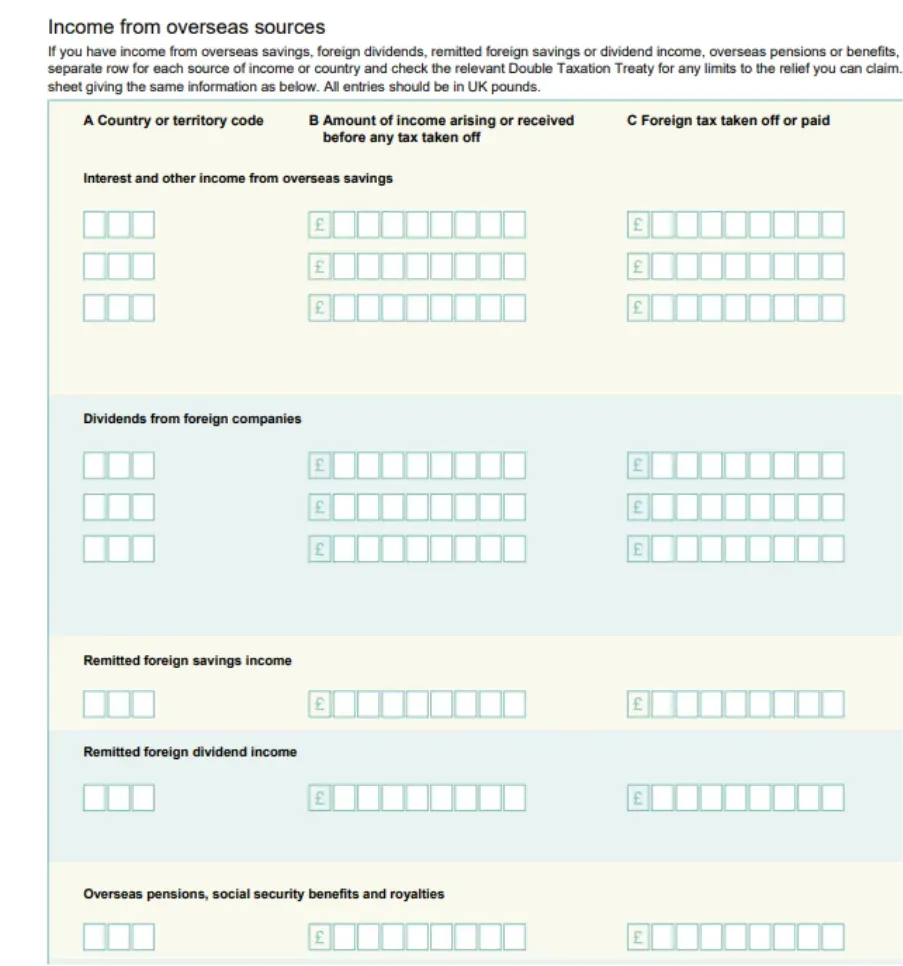
Foreign income must be declared in the foreign income section of your Self-Assessment tax return via supplementary pages SA 106. Understanding the process and deadlines is important to maintaining compliance.
Registration and Deadlines
In the tax year following when your foreign income begins, you need to register online for Self-Assessment for tax on foreign income UK . The UK tax year runs from 6 April to 5 April of the following year. If you do not usually send a tax return, you need to tell HMRC by 5 October following the tax year you had the income by registering for Self Assessment.
Once registered, you'll receive a Unique Taxpayer Reference (UTR), a ten-digit number that identifies you to HMRC. If you've submitted tax returns in previous years but missed last year, you can use your existing UTR to re-register online. The same registration and submission due dates apply regardless of whether you're a new or returning filer.
Your completed tax return must be submitted online by midnight on 31 January following the end of the tax year. Missing this deadline can result in automatic penalties and interest charges for tax on foreign income UK.
Tax on Foreign Income UK: Avoiding Double Taxation
One of the major concerns for people with foreign income is the possibility of paying tax twice on the same earnings, once in the country where the income was earned and again in the UK.
Fortunately, the UK has established methods to prevent this. UK residents may not have to pay UK tax on foreign income if they are eligible for foreign income and gains relief. Alternatively, foreign tax credit relief allows you to claim credit for tax already paid abroad if you are not eligible for or choose not to use FIG relief. This relief ensures you're not unfairly penalised for earning income internationally.
The specifics of claiming this relief depend on whether the UK has a double taxation agreement with the country where you earned the income. These agreements vary by country and determine which nation has primary taxing rights and how relief is calculated.
Declaring Income from Previous Years
If you've earned foreign income in previous tax years but haven't declared it, you can use HMRC's Worldwide Disclosure Facility to regularise your tax affairs. This facility allows you to voluntarily disclose previously undeclared foreign income and pay any outstanding tax.
Making a voluntary, unprompted disclosure through the WDF typically results in significantly lower penalties than if HMRC discovers the undeclared income through their investigations. Penalties vary based on your behaviour (careless vs deliberate) and can range from 30% to 200% of the unpaid tax in the most serious cases. You should notify HMRC of your intention to disclose as soon as possible and seek professional advice before making a disclosure.
Foreign Income and Gains (FIG) Regime (from 6 April 2025)
Starting 6 April 2025, the Foreign Income and Gains (FIG) regime replaced the old remittance basis for non-domiciled taxpayers. If you are a new resident who has lived outside the UK for at least 10 years before moving, you can get full UK tax relief on foreign income and gains for your first four years in the UK. However, if you claim FIG relief, you lose your UK personal allowance and capital gains tax exemption for that year. You still need to report tax on foreign income UK on your Self Assessment return, even if you claim FIG relief. This area is complicated, so it’s best to get professional advice if you think you qualify.
Important Considerations
Reporting foreign income is often more complicated than reporting UK income for several reasons:
Currency Fluctuations
You'll need to convert foreign income into pounds sterling using appropriate exchange rates for the date you received the income or an average rate for the period.
Record keeping
Keep full records of all your foreign income, such as bank statements, dividend slips, rental contracts, and proof of any foreign tax paid. These documents are important if HMRC asks about your return.
Different tax years
Many countries have tax years that don’t match the UK’s 6 April to 5 April cycle. You’ll need to match your foreign income to the right UK tax year, even if your foreign documents use different dates.
Changes from 6 April 2025
Before this date, non-UK domiciled people didn’t have to report or pay UK tax on unremitted foreign income and gains under £2,000. This rule ended on 6 April 2025. Now, under the new Foreign Income and Gains (FIG) regime, UK residents must report all foreign income on their Self Assessment tax return, no matter the amount, unless they don’t file a return and owe no UK tax on that income.
Getting Help
Tax on foreign income can be complicated, especially if you have income from several countries or large investments. If you’re not sure about your responsibilities or how to fill out your return, it’s a good idea to get help from a qualified accountant or tax advisor.
Conclusion
UK residents must understand and report foreign income correctly, but the process doesn’t have to be stressful. If you know what counts as foreign income, register for Self-Assessment on time, and learn how to claim relief for foreign tax paid, you can stay compliant and avoid paying more tax than you need to.
It’s always best to be open with HMRC. If you’re unsure about any part of your foreign income or tax duties, get advice early to avoid penalties for late or incorrect reporting. The UK system offers clear ways to declare tax on foreign income and avoid double taxation, so you can handle your international finances with confidence.
FAQs
General Questions
What exactly counts as foreign income?
Foreign income is any income earned from sources outside England, Scotland, Wales, and Northern Ireland. This includes wages from work performed outside the UK, dividends and interest from foreign investments, rental income from overseas properties, and pensions held abroad. Income from the Channel Islands and Isle of Man also counts as foreign income for UK tax purposes.
Do I need to report foreign income if I've already paid tax on it abroad?
Yes. If you're a UK resident, you must declare all foreign income to HMRC through your Self-Assessment tax return, even if you've already paid tax on it in another country. However, you may be able to claim Foreign Tax Credit Relief to avoid paying tax twice on the same income.
How do I know if I'm a UK resident for tax purposes?
Your residence status is determined by the Statutory Residence Test (SRT), which evaluates aspects including the number of days you spend in the UK, your ties to the country, where you work, and where your family lives.
Registration and Reporting
When do I need to register for Self-Assessment?
You must register for Self-Assessment by 5 October in the tax year after your foreign income starts. For example, if you start receiving foreign income in the 2025/26 tax year (which runs from 6 April 2025 to 5 April 2026), you must register by 5 October 2026.
What is a Unique Taxpayer Reference (UTR)?
A UTR is a ten-digit number that HMRC issues to identify you in their system. You receive this when you first register for Self-Assessment. You'll need this number for all future tax returns and correspondence with HMRC.
I've filed tax returns before but skipped last year. Do I need a new UTR?
No, you can use your existing UTR to re-register online for Self-Assessment. However, the same deadlines apply—you must register by 5 October and submit your return by 31 January.
What's the deadline for submitting my Self-Assessment tax return?
You must submit your online Self-Assessment tax return by midnight on 31 January following the end of the tax year. For instance, for the 2025/26 tax year (ending 5 April 2026), the deadline is 31 January 2027.
What happens if I miss the deadline?
Missing the 31 January deadline results in automatic penalties. You'll face an immediate £100 fine, with additional penalties accruing if the return remains outstanding. Interest is also charged on any unpaid tax from the original deadline.
Double Taxation and Tax Relief
What is Foreign Tax Credit Relief?
Foreign Tax Credit Relief is a mechanism that allows you to reduce your UK tax bill by the amount of tax you've already paid abroad on the same income. This prevents you from being taxed twice on the same earnings.
How do I claim Foreign Tax Credit Relief?
You claim this relief through your Self-Assessment tax return in the foreign income section. You'll need evidence of the foreign tax paid, such as tax certificates or statements from the foreign tax authority.
Does the UK have tax treaties with other countries?
Yes, the UK has double taxation agreements with many countries. These treaties determine which country has primary taxing rights and how relief is calculated. The particular terms vary by country, so check the relevant agreement for your situation.
Can I get a full refund of foreign tax paid if I claim relief?
Foreign Tax Credit Relief allows you to claim credit for tax already paid abroad, subject to limitations. Generally, you can claim relief for the lower of either the foreign tax paid or the UK tax due on that same income. This relief helps prevent double taxation, though you cannot usually claim UK relief for foreign tax that exceeds the UK tax liability on the same income. Where double taxation agreements exist, specific provisions in those treaties may affect how relief is calculated.
For example, Annie receives £1,000 French property income dividends with £200 foreign tax paid. If, the allowable rate for French property income dividends is 15%, the amount of foreign tax Annie can claim for is £150. The excess of £50 paid in France is not available for credit against the UK tax liability. Annie may be able to recover this amount from the French Tax authorities.
Specific Income Types
I work remotely for a UK company while traveling abroad. Is this foreign income?
Employment income is sourced where the work is actually done. If you are physically located outside the UK while working, those earnings qualify as foreign income, regardless of where the employer is based. Your residence status and the exact circumstances will determine your reporting obligations.
Do I need to report interest from a foreign bank account?
Yes, if you're UK resident, you must report all foreign investment income, including interest from overseas bank accounts, regardless of the amount. Though you do not need to fill in a tax return if your only foreign investment income is dividends and your total dividends are less than the £500 dividend allowance.
I rent out a property abroad. How do I calculate the taxable amount?
You report the rental income and can deduct allowable expenses such as maintenance, management fees, and mortgage interest (subject to UK rules). You'll need to convert the income and expenses to pounds sterling using appropriate exchange rates.
What about foreign pensions?
Foreign pensions are generally taxable in the UK if you're UK resident. You must declare pension income from overseas schemes on your Self-Assessment return. Some countries have specific rules about pension taxation in their double taxation agreements with the UK.
Currency and Calculations
How do I convert foreign income to pounds sterling?
You should use the exchange rate applicable on the date you received the income. Alternatively, HMRC publishes average monthly exchange rates that you can use. Choose one method and apply it consistently throughout your tax return.
The foreign tax year doesn't match the UK tax year. How do I report this?
You need to allocate income to the correct UK tax year (6 April to 5 April). This may require apportioning income from foreign tax documents across two UK tax years or converting between different accounting periods.
Previous Years and Disclosure
Is there a minimum amount of foreign income I don't need to declare?
No, you must declare all foreign income regardless of the amount if you're UK resident. The previous £2,000 de minimis threshold was abolished from 6 April 2025, so there is no longer a minimum threshold below which foreign income does not need to be reported.
I didn't realise I needed to declare foreign income in previous years. What should I do?
You can use HMRC's Worldwide Disclosure Facility to voluntarily disclose previously undeclared foreign income. This facility allows you to regularise your tax affairs and typically results in more favourable treatment than if HMRC discovers the omission themselves.
How far back can HMRC investigate?
HMRC can generally go back four years for innocent errors, but can investigate up to 20 years if they suspect deliberate tax evasion. Voluntary disclosure through the Worldwide Disclosure Facility is always advisable if you've failed to declare income.
Will I face penalties for not declaring foreign income in the past?
Penalties depend on whether the non-disclosure was innocent, careless, or deliberate. Making a voluntary disclosure through the Worldwide Disclosure Facility typically reduces penalties significantly compared to waiting for HMRC to discover the issue.
Record Keeping
What records do I need to keep?
You is advised to maintain complete records including foreign bank statements, dividend vouchers, rental agreements, evidence of foreign tax paid, exchange rate calculations, and any correspondence with foreign tax authorities. Keep these records for at least five years after the 31 January filing deadline.
Do I need to keep documents in English?
While HMRC may accept documents in foreign languages, it's advisable to have translations available, notably for complex documents or if HMRC queries your return.
Getting Help
Should I hire an accountant?
If your foreign income is simple, you may be able to complete your return yourself using HMRC's online system. However, if you have complex income sources, multiple countries involved, or significant amounts at stake, professional advice from a qualified accountant specialising in international tax is highly recommended.
Can HMRC complete my tax return for me?
No, HMRC cannot complete your tax return for you, but they are able to provide general guidance on how to complete it and answer specific questions about what information is required.
What if I disagree with HMRC's assessment of my foreign income?
If you believe HMRC has made an error in assessing your tax liability, you can appeal the decision. You must usually appeal within 30 days of receiving the assessment. Consider seeking professional advice if you're disputing a significant amount.
About the author
Sanjay Gautam, a seasoned Chartered Accountant, brings over seven years of experience in accounting, finance, and taxation. He has held notable roles at Credit Suisse, HSBC, and Fintech. His expertise in tax planning, compliance, and financial management are truly exceptional. Holds a Master's in Business Studies.
Introducing RentalBux: Our MTD Software for Landlords
Generic software doesn’t understand property businesses and requires manual intervention to meet deadlines. That’s why we developed RentalBux!
- Built by Property Experts
- Designed for UK Landlords
- HMRC Recognised and MTD Compliant
Confused Where To Start?
Schedule a Free 15-minute discovery call by providing your contact details, mentioning your requirements, and selecting a convenient date for the call.
How our discovery call works:
- Complete Our Contact Form
- Discovery Calls Scheduled
- Receive a Tailored Proposal