


Land and Buildings Transaction Tax (LBTT), introduced on April 1, 2015, is a tax levied on property transactions in Scotland. LBTT replaced the UK Stamp Duty Land Tax (SDLT) for Scottish properties. For residential properties, LBTT is charged on properties with a value over the threshold of £145,000. Above this amount, increasing tax rates apply to different portions of the property value, with higher rates for more expensive properties.
These thresholds are designed to ensure fairness, with lower-value transactions often exempt from tax, while higher-value properties contribute progressively more. However, for transactions valued above the threshold, LBTT also provides various reliefs subject to different conditions. Among the various reliefs available, Multiple Dwelling Relief (MDR) stands out as a significant mechanism designed to reduce the tax burden for purchasers acquiring multiple dwellings in a single or a series of linked transactions, ensuring they don't pay disproportionate tax compared to purchasing a single property. Although MDR has been abolished in England and Northern Ireland for transactions completed or substantially performed after 1 June 2024, the relief remains applicable in Wales and Scotland. This guide provides a detailed discussion of MDR in Scotland.
If a MDR claim is successful under the LBTT, the tax liability is reduced by calculating the tax based on the average value of the dwellings purchased rather than the total consideration. MDR can lead to substantial tax savings, particularly in transactions involving high-value properties. MDR is particularly beneficial for property investors, developers, and individuals purchasing multiple residential units, such as flats in a block or houses in a development.

However, the relief is subject to specific conditions, requires careful calculation and may be withdrawn under certain circumstances. As such, it is recommended to consult with a professional to ensure an accurate assessment and avoid either overpayment of LBTT or overestimation of the relief.
What is MDR?
The provisions regarding MDR is provided under Schedule 5 of the Land and Buildings Transaction Tax (Scotland) Act 2013 (the “Act”).
At its core, MDR is rooted in the principle of preventing disproportionate taxation that would arise from treating the purchase of multiple dwellings as a single, large-value transaction. Because LBTT is charged on a slab basis, without MDR, buyers engaging in such transactions would face significantly higher LBTT rates than those purchasing individual properties. This punitive effect could stifle investment in the Scottish housing market, discourage the development of multi-dwelling properties, and ultimately impede the efficient functioning of the property sector. MDR, therefore, serves as a vital instrument in fostering a balanced and equitable tax regime, one that acknowledges the distinct nature of multiple dwelling acquisitions.
The relief is available when two or more dwellings are purchased as part of a single transaction or a series of linked transactions.
A "dwelling" is defined as a building or part of a building that is suitable for use as a single residence. This includes houses, flats, and other residential properties, but excludes commercial properties or mixed-use properties unless they contain separate residential units.
Conditions for Availing MDR
For the purposes of MDR, a “relevant transaction” is a transaction that involves the purchase or acquisition of two or more dwellings in a single transaction or as part of a series of linked transactions. Particularly:
Therefore, for MDR to apply, the transaction must meet the criteria for being a relevant transaction, and the relief is designed to reduce the overall LBTT liability by calculating the tax based on the average value of the dwellings rather than the total purchase price.
Specifically, land transactions classified as leases for LBTT purposes are excluded for the purpose of MDR. The imposition of LBTT on leases, as outlined in Schedule 19 of the Act, aligns with the principle that tax policies should avoid influencing commercial decisions between leasing and purchasing property. Furthermore, MDR cannot be claimed if any of the specified reliefs are available or have been withdrawn in a previous return:
- Group Relief
- Reconstruction Relief and Acquisition Relief
- Crofting Community Right to Buy Relief
- Charities Relief
Also, even though MDR, as the name suggests, is a relief for dwellings, if a transaction or linked transaction includes acquisition of non-residential property along with the dwellings, MDR still can be claimed. For such transactions, the chargeable consideration for the relief is the portion of the consideration attributed specifically to dwellings in a fair and reasonable manner. The consideration for non-residential property is the remaining amount after deducting the dwelling-related portion. This ensures that MDR can be applied appropriately even in transaction involving both dwellings as well as non-residential properties.
Example: 1
Chargeable consideration in transaction including dwellings and non-residential properties
If "A" acquires 3 dwellings and 1 non-residential property, the chargeable consideration for the purpose of MDR is based on the value of the 3 dwellings. While the LBTT chargeable on the 3 dwellings is subject to MDR, the LBTT chargeable on the remaining property is calculated based on the non-residential rate, and no MDR will be available for that portion.
What is a Dwelling?
The precise application of MDR hinges on an accurate understanding of the terminology employed within the LBTT framework. The definition of the term “dwelling”, for instance, forms the foundation of the relief and is critical to determining eligibility and calculating the tax liability.

In the context of a relevant transaction, a dwelling refers to the residential property that form the primary subject of the transaction. A building or part of a building qualifies as a dwelling if it is used, suitable for use, or being constructed or adapted for use as a single residential unit.
While the term "dwelling" is not explicitly defined in LBTT legislation, Revenue Scotland adopts its everyday meaning:
- a building or part of a building that provides the facilities necessary for day-to-day private domestic living and exhibits a sufficient degree of permanence
- buildings under construction or is being adapted for such use
Additionally, land intended for use as a garden or grounds, including any structures on it, is considered part of the dwelling, as is any land that benefits the property. These criteria ensure a comprehensive assessment of what constitutes a dwelling under LBTT.
Considerations to Determine a Dwelling
In the context of MDR, determining whether a property qualifies as a dwelling entails the identification of specific characteristics. No single characteristic is decisive; instead, a combination of characteristics is evaluated to assess whether the property is suitable for use as a residential unit.
The LBTT MDR technical guidance has highlighted some relevant considerations:
- Physical layout, including independent access
- Availability of bathroom and kitchen facilities
- Living and sleeping accommodations
- Security features, such as locks and doors
- Degree of permanence
- Control of utilities
The list provided is only illustrative and not exhaustive. Moreover, not all factors carry equal significance, nor is it necessary for every factor to be fully satisfied. For example, elements such as having independence, or security features, are accorded greater weightage compared to other considerations. Moreover, the relative weight assigned to each factor is determined on a case-by-case basis, depending on the specific circumstances of the property in question.
In general, what is crucial is that the dwelling must provide a sufficient degree of permanence and must be equipped to support day-to-day private domestic living.
Example: 2
House divided into three separate flats
If a large house is divided into three separate flats, each flat maybe considered an individual dwelling provided they fulfil criteria for a dwelling. For example, a single-family home converted into three self-contained units with independent access, kitchens, and bathrooms would be classified as three dwellings for LBTT purposes.
Example: 3
Dwelling on a site scheduled for refurbishment or demolition
A dwelling on a site scheduled for refurbishment or demolition is still classified as a dwelling, provided it is not derelict. For instance, a house in need of renovation but still structurally sound and capable of being used as a residence would qualify as a dwelling. However, a derelict property that is uninhabitable may not meet the criteria.
Example: 4
Holiday homes or holiday lets
Holiday homes or holiday lets, even those that are not usable year-round (e.g., seasonal properties), are considered residential properties and therefore qualify as dwellings. For example, a coastal cottage used as a holiday let during the summer months would still be classified as a dwelling.
Example: 5
Furnished holiday letting business
Properties used as part of a furnished holiday letting business are treated as residential properties, regardless of whether they are assessed for Council Tax or Non-Domestic Rates. This is because such properties could typically be used as a single dwelling without requiring additional permissions from the local authority. For example, a cottage rented out as a holiday let but capable of being occupied as a private residence would qualify as a dwelling.
Example: 6
Cleared site with no buildings
A cleared site with no existing buildings does not qualify as a dwelling, even if it has planning permission for residential construction. For example, an empty plot of land approved for building a house would not be considered a dwelling until construction is completed.
Example: 7
Caravans, mobile homes, or houseboats
Caravans, mobile homes, or houseboats are generally not considered dwellings unless they are permanently fixed to the land and meet the standard definition of a dwelling. For instance, a mobile home placed on a foundation and connected to utilities in a way that makes it a permanent structure could potentially qualify as a dwelling. However, a caravan used for temporary accommodation would not meet the criteria.
These examples illustrate how the classification of a property as a dwelling depends on its physical characteristics and permanence.
Effective Date of Transaction
The “effective date of transaction” is the date on which the transaction is considered to have taken place for LBTT purposes. Meaning, this is the date on which the liability for LBTT is triggered (the tax point). This date is also critical in establishing the timeline for fulfilling other tax-related obligations, such as the submission of LBTT return.
Generally, this is the date of completion of a transaction. But, in certain cases, where there is a substantial performance of the contract (such as if the purchaser is allowed to take possession of the property before the completion of contract), the effective date, for MDR purposes, includes:
- When there is substantial performance of a contract under relevant deeming provisions (such as provision regarding substantial performance without completion, provided under Section 10 of the Act, or contracts providing for conveyance to a third party, provided under Section 11 of the Act).
- The transaction involves an interest in a building or part of a building that is intended to be constructed or adapted under the contract for use as a single dwelling; and
- The construction or adaptation of the building or relevant part has not commenced by the time the contract is substantially performed.
Basically, the main subject-matter of a transaction is also considered to consist of or include an interest in a dwelling under these specific circumstances. This ensures that transactions involving future residential properties are appropriately assessed under LBTT rules.
How MDR Works
The primary benefit of MDR is that it allows the LBTT liability to be calculated based on the average value of the dwellings purchased, rather than the total consideration. This can result in significant tax savings, particularly when the properties involved are high value.
Additionally, if the relevant transaction involves the acquisition of non-residential property alongside dwellings, the fair and reasonable consideration attributable to the non-residential portion must be deducted before applying MDR. This ensures that the relief is calculated only on the residential component of the transaction.
But the interplay between MDR and the Additional Dwelling Supplement (ADS) introduces complexities. If a buyer already owns another dwelling and purchases multiple dwellings, both MDR and ADS may apply. Meaning, ADS is calculated differently depending on whether:
- ADS is payable
- No ADS is payable
It is also important to note that when 6+ dwellings are acquired in a single transaction the transaction is treated as non-residential for the purposes of LBTT. Consequently, ADS charge does not apply, even if the properties acquired include dwellings.
Also, in cases where claiming MDR may not be beneficial compared to available non-residential rates, as applicable in this instance, the buyer can choose not to opt for MDR.
Example: 8
Cases where there are 6+ dwellings, and no ADS is chargeable

In an acquisition valued £950,000 involving 7 dwellings.
Since the acquisition includes 6 or more dwellings, the ADS will not be included in the calculation of MDR. This classification treats the transaction as non-residential, thereby exempting it from ADS charges.
The calculation for MDR is structured as follows:
Rate of MDR when no ADS is applicable
Tax Due in Relation to a Dwelling (DT) × Number of Dwellings that Form the Main Subject-matter of the Transaction (ND) + Tax Due in Relation to Remaining Property That Is Not a Dwelling (RT)
Illustration
Step 1: Begin by determining the total consideration attributable to all dwellings involved in the transaction.
Step 2: Divide the total consideration attributable to the dwellings by the total number of dwellings to calculate the average consideration per dwelling.
Step 3: Compute the tax due (DT) by applying the applicable LBTT rates to the average consideration derived in Step 2.
Step 4: Multiply the DT by the total number of dwellings to determine the total tax liability for the residential portion of the transaction.
Step 5: Finally, add the LBTT attributable to any non-residential properties, if applicable, to arrive at the overall tax liability for the transaction.
Rate of MDR when ADS is applicable
Sum of the Tax Due (∑DT) + Tax Due in Relation to Remaining Property That Is Not a Dwelling (RT)
Illustration
Step 1: Begin by determining the total consideration attributable to all dwellings involved in the transaction.
Step 2: Divide the total consideration attributable to the dwellings by the total number of dwellings to calculate the average consideration per dwelling.
Step 3: Compute the tax due (DT) by applying the applicable LBTT rates to the average consideration derived in Step 2.
Step 4: While computing DT, where applicable, apply an ADS charge of 8% to each dwelling subject to ADS.
Step 5: Sum the tax due for all dwellings, including any applicable ADS charges. This total will represent ∑DT in the equation.
Step 6: Finally, add the LBTT attributable to any non-residential properties (RT), if applicable, to determine the overall tax liability for the transaction.
Note that not all dwellings may be subject to ADS; for example, if one of the dwellings replaces the buyer’s main residence, it may be exempt from ADS.
Example: 9
Where ADS does not apply to all dwellings
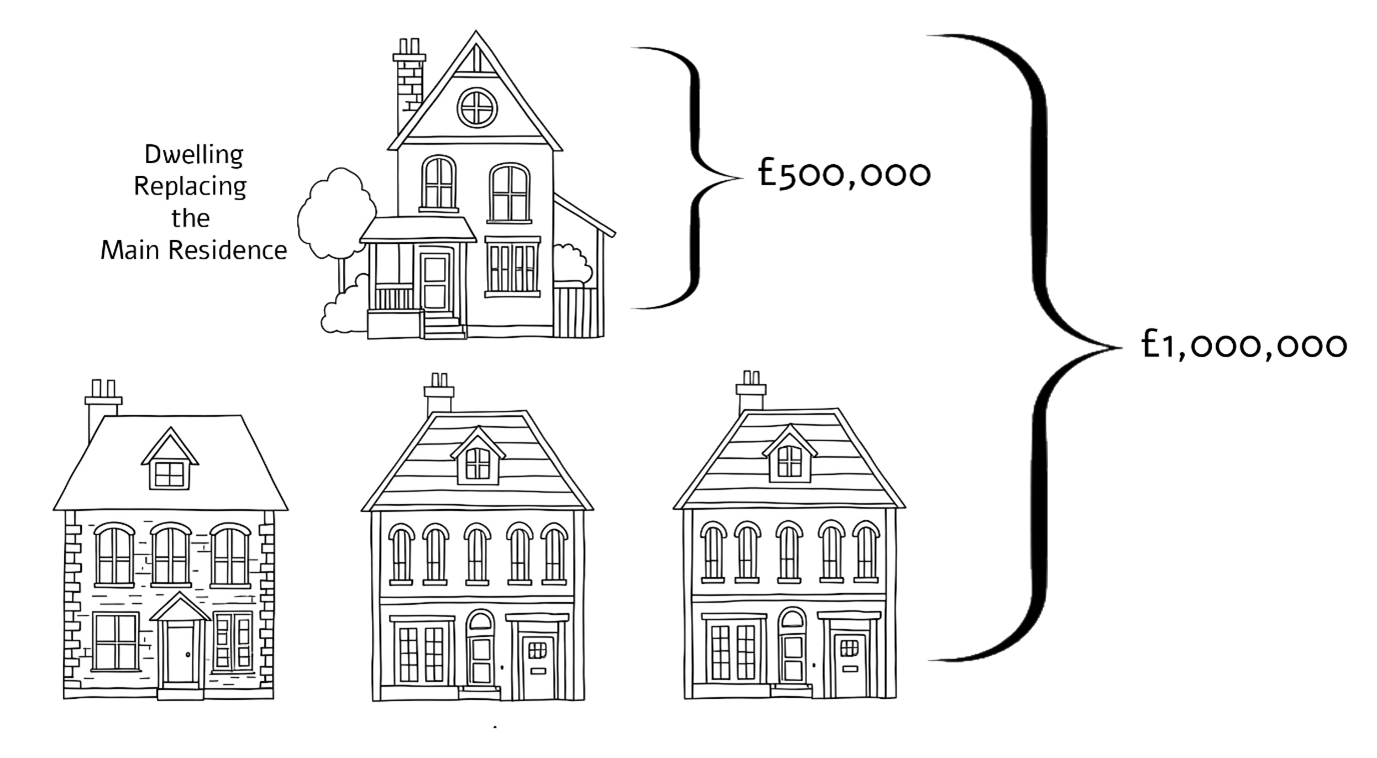
In an acquisition valued £1,000,000 of 4 dwellings, ADS is due only on 3 of those dwellings, as one of the property is replacing the purchaser’s main residence. The main residence itself is valued at £500,000.
In this scenario, ADS is calculated based on the average consideration per dwelling. Although ADS is applicable only to the 3 properties collectively valued at £500,000, the calculation is performed using the average value of £250,000 per dwelling (total consideration divided by the number of dwellings).
Consequently, ADS is effectively applied to a total value of £750,000 (3 dwellings × £250,000), rather than the actual value of the 3 properties subject to ADS.
Additionally, a Minimum Prescribed Amount (MPA) must also be calculated to ensure compliance with LBTT regulations. If the tax liability calculated under MDR falls below the threshold set by the MPA, the MPA will instead be applied as the minimum tax payable. This safeguard ensures that a baseline level of tax is always collected, even when MDR results in a reduced liability.
The MPA calculation is as follows:
Rate of MPA
Total Tax Due Without Relief (TT) – Tax Due in Relation to Remaining Property That Is Not a Dwelling (RT) × 25%
Where the DT × ND (or ∑DT) amount from the mentioned method is less than the MPA, the amount of tax chargeable in relation to the relevant transaction is MPA + RT.Explanation
Step 1: Calculate the total tax due for dwellings as if no relief is applicable. This will be shown in the equation with (TT).
Step 2: while calculating TT, also include any ADS if applicable.
Step 3: Calculate the tax due in relation to non-residential properties (RT), where applicable.
Step 4: Subtract RT form TT and multiply the result by 25%. This will be the MPA figure.
Step 5: If rate of MDR, calculated from relevant method (DT × ND; or ∑DT), is below this figure the tax chargeable will be MPA + RT.
Example: 10
Where MDR calculated falls below the MPA
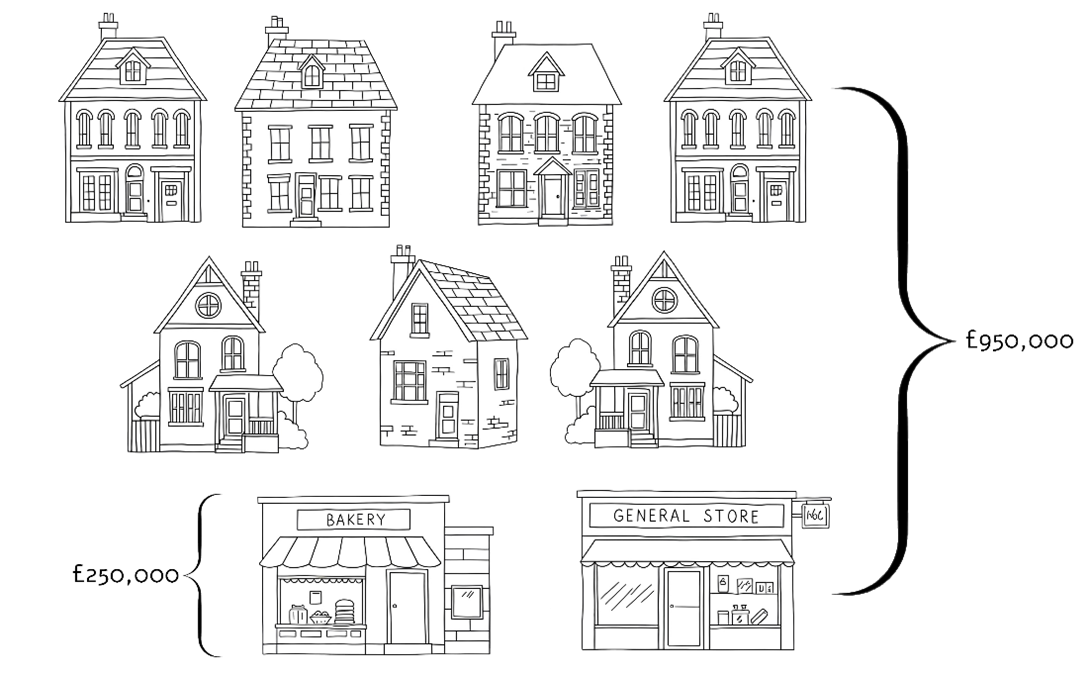
In an acquisition valued £950,000 of 7 dwellings and 2 shop units (whose chargeable consideration attributable to the shops is apportioned on a just and reasonable basis to be £250,000). Here, because there are more than 6 dwellings, ADS will not be charged.
The average consideration for a single dwelling is calculated as £100,000 (£700,000 total for dwellings ÷ 7), which falls within the Nil Rate Band for LBTT. As a result, the tax due for the dwellings (DT × ND) is £0.
However, the MPA in this case is £6,630. Since the MPA is higher than the tax calculated for the dwellings (DT × ND), the LBTT liability will be determined using the formula MPA + RT, where RT represents the tax due on the non-residential portion (shops). This ensures that a minimum level of tax is paid, even when the residential portion falls within the Nil Rate Band.
Additionally, there are scenarios where claiming MDR may not be advantageous, highlighting the need for careful evaluation to determine the most tax-efficient approach.
Example: 11
Where it is not beneficial to claim MDR
In an acquisition valued £1,250,000 of 2 flats and 2 ground floor shop units (whose chargeable consideration attributable to the shops is apportioned on a just and reasonable basis to be £250,000).
Since ADS applies in this case, the calculation under MDR results in ∑DT = £126,700. The tax due for the non-residential properties (RT) is £26,200, leading to a total tax liability of £152,900 after claiming MDR.
However, if MDR is not claimed, the LBTT liability for the entire transaction (2 flats and 2 shop units – mix use property) would be calculated using non-residential rates. In this scenario, the total tax due in the absence of the relief (TT) would be £131,000. This illustrates that claiming MDR in this instance results in a higher tax liability (£152,900) compared to not claiming it (£131,000).
Clawback
MDR may be fully withdrawn if an event occurs within the relevant period that, had it taken place immediately before the effective date of the transaction, would have rendered the relief ineligible. In such cases, the tax liability reverts to the amount that would have been chargeable had the relief not been claimed.

Similarly, MDR may be partially withdrawn if an event occurs within the relevant period that, had it occurred immediately before the effective date, would have still allowed the relief but resulted in a higher tax liability.
In these instances, the tax is recalculated as if the event had taken place immediately before the effective date, using the rates and bands applicable at that time.
The relevant period is defined as the shorter of:
- Three years from the effective date of the transaction, or
- The period between the effective date and the date the buyer disposes of the dwelling(s) to a person not connected to them.
An event includes any change in circumstances or plans, such as:
- Physically altering the properties (e.g., merging two dwellings into one).
- Selling or transferring one or more of the properties.
- Using the properties differently than originally intended.
If such a change had occurred before the effective date, the criteria for claiming MDR would not have been met.
Additionally, any withdrawal of MDR—whether in full or in part—may also impact the Additional Dwelling Supplement (ADS), potentially altering the overall tax liability. This ensures that MDR is only retained when the conditions for eligibility are consistently met throughout the relevant period.
Example: 12
Full Withdrawal of MDR
A buyer acquires multiple dwellings and claims MDR, but subsequently merges them into a single dwelling within the first year. Had the property already been a single dwelling at the time of purchase, MDR would not have been applicable.
As a result, MDR is fully withdrawn, and the original tax relief is reversed, requiring the buyer to pay the tax that would have been due without the relief.
Example: 13
Partial Withdrawal of MDR
A buyer acquires three dwellings and claims MDR but later sells one of them within the first year. If the buyer had originally acquired only two dwellings instead of three, they would still have qualified for MDR but at a different tax rate.
Given the change in circumstances, the tax liability is recalculated based on the revised situation, resulting in a partial withdrawal of MDR.
In both cases, the withdrawal of MDR—whether in full or in part—may also impact the ADS, potentially altering the overall tax liability. This ensures that the relief is only retained when the conditions for eligibility are consistently met throughout the relevant period.
Conclusion
MDR is a valuable tool under the LBTT framework, offering significant tax savings for purchasers of multiple residential properties. By calculating the tax based on the average value of the dwellings rather than the total consideration, MDR makes it more affordable for individuals and businesses to invest in residential property in Scotland.
However, claiming MDR requires a thorough understanding of the eligibility criteria, careful calculation of the tax liability, and adherence to Revenue Scotland’s guidelines. Buyers should also be aware of the limitations and potential complexities associated with MDR, particularly when dealing with linked transactions or mixed-use properties.
For those considering a purchase that may qualify for MDR, seeking professional advice is highly recommended. Revenue Scotland’s guidance provides a comprehensive resource, but the application of the relief can be complex, and expert support can help ensure compliance and maximise tax savings. By leveraging MDR effectively, buyers can make informed decisions and optimise their property investments in Scotland.

